
Hartford County Court Records After a Jail Arrest
Connecticut does not run county jails through a county sheriff. After a Hartford County arrest, a city, town, or state police agency books the person, and custody runs through the state. The court side is separate. Once the file reaches a prosecutor, that prosecutor decides which charges to file. The charges open a Superior Court case, and that case is the court record. It carries a docket number, a charge list, hearing dates, and a disposition. Arrest paperwork starts the story, but the court record is what tracks the charges from first appearance to the end of the case.
Keep the two records apart in your mind. The custody side shows who is held and on what bond, and you can read more about that on the jail inmate records page, while booking photos are covered on the jail roster mugshots page. The court record is the charge record. It lists the charges a state's attorney actually filed, not just the codes officers wrote at the scene. People often confuse an arrest charge with a court charge, but they are not always the same. The court record settles which charges moved forward and how each one ended.
Arrest Record, DOC Offense, and Court Charge Are Different
Three records describe the same arrest, and each shows something different. The police arrest record lists what officers charged at the scene. The Connecticut Department of Correction profile lists a controlling offense if the person is held in state custody. The court case record lists the charges a prosecutor filed. These can disagree. A booking charge can be dropped, reduced, or replaced once a state's attorney reviews the file.
The Hartford Police daily arrest log is the police side. It posts as a PDF and shows arrest fields rather than court status. The Department of Correction profile is the custody side. It may show a single controlling offense and a bond amount, but it is not the full charge list. The court record is the charge side. It is the place where the filed charges, their codes, and their outcomes live. When the three records differ, the court case is the one that governs what charges are actually pending.
| Record | Source | What It Shows |
|---|---|---|
| Arrest record | Arresting police agency | Charges listed at the time of arrest, before prosecutor review |
| Controlling offense | Connecticut DOC inmate profile | The primary offense controlling custody, not every charge |
| Court charge | Connecticut Judicial Branch case | The charges the state's attorney filed and how each one ends |
Note: A person can be listed in state custody and still not be convicted, because the Department of Correction holds many people on accused status awaiting trial.
Search the Connecticut Judicial Branch for Court Records
Court charges after an arrest live in the Connecticut Judicial Branch system, not with a county clerk. The Judicial Branch criminal and motor vehicle case lookup lets the public search pending cases and conviction or bond-forfeiture cases for free. The Division of Criminal Justice points people to this lookup and is clear that it does not hand out criminal records itself. One caution matters: the online lookup is a public service, not the official court record. The Judicial Branch disclaimer says the clerk's office holds the official and certified record.
The official lookup page helps confirm you are using the real state portal and not a copy. The screenshot below comes straight from the source.
The lookup screen is shown on the Judicial Branch criminal and motor vehicle case lookup page.
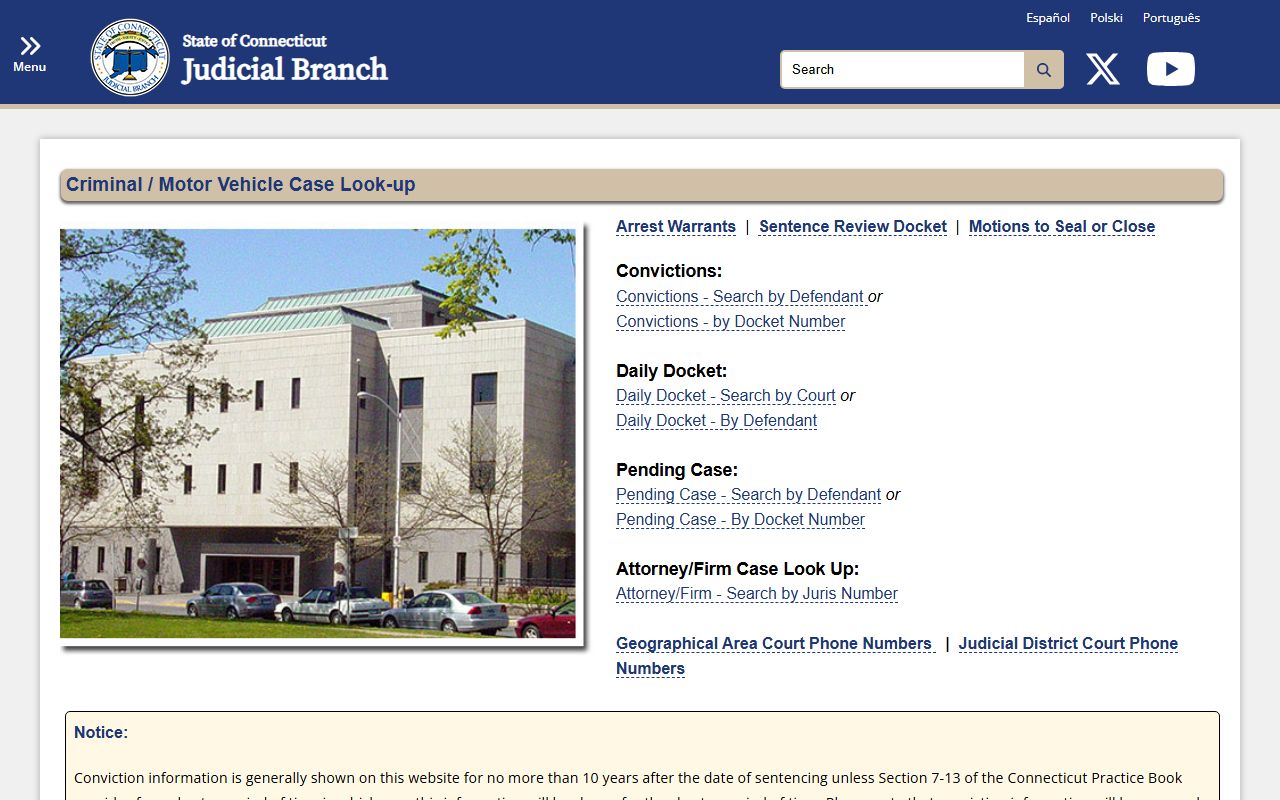
Use that lookup to read the charge list and the status of a Hartford County case once a prosecutor has filed it. The search fields are simple, and the table further down breaks them out.
- Open the Judicial Branch criminal and motor vehicle case lookup and read the public-service disclaimer.
- Search by the defendant's last name, by a docket number from court or arrest paperwork, or by the docket and schedule for a specific court.
- Open the matching case and read the full charge list with each charge code and description.
- Check the status and disposition of each charge, since some may be amended, reduced, dismissed, or nolled.
For an official criminal-history check, the court lookup is not the right tool. The Division of Criminal Justice routes conviction-history requests to the DESPP State Police criminal history records process. Use the Judicial Branch lookup for case status and DESPP for an official record of convictions.
Search Fields for Hartford County Court Records
The Judicial Branch lookup gives three search paths, and any one of them can find a case. If you have court or arrest paperwork, the docket number is the fastest. If you only have a name, the defendant's last name will work. If you know which court is hearing the case, you can browse that court's docket and schedule. The table lists each field, its type, and what to expect.
| Field | Type | Required | Notes |
|---|---|---|---|
| Defendant last name | Text | One search path | Official descriptions say cases can be searched by the defendant's last name. |
| Docket number | Text | One search path | Use the docket number listed on court paperwork, police paperwork, or a DOC or court reference. |
| Court docket / schedule | Court and date selection | One search path | Lets you see cases on the docket or schedule for a particular court. |
| Disclaimer acknowledgment | Page notice | May be required | The lookup is a public service and not the official record of the court. |
A Hartford County arrest may land in one of several courts, since Hartford Correctional Center serves the superior courts in Bristol, Enfield, Hartford, Manchester, Middletown, New Britain, Rockville, and West Hartford. If you are not sure which court has the case, search by last name first and let the result tell you the court location.
Who Files Charges After a Hartford County Arrest
Connecticut does not use county district attorneys. Some states call this office the district attorney, but Connecticut vests prosecutorial power in the Chief State's Attorney and the state's attorney for each judicial district. After police make an arrest, a state's attorney in the right judicial district reviews the file and decides which charges to bring in Superior Court. The arresting officer's charges and the DOC controlling offense may not match the charges that are finally filed.
The Division of Criminal Justice judicial districts and state's attorneys page lists each district and explains where prosecutorial power sits. The image below is from that official page.
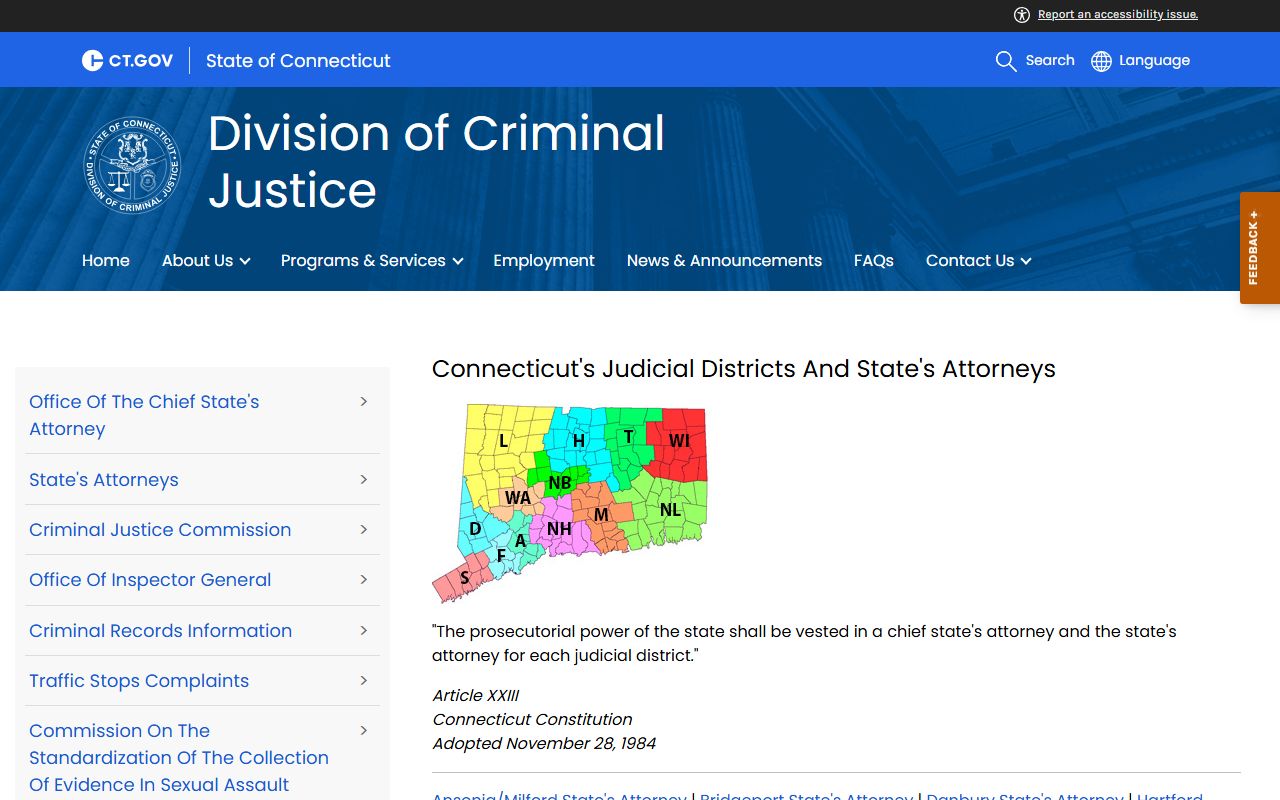
Two judicial districts matter most for Hartford County arrests. The Hartford Judicial District covers the capital city and 18 surrounding communities, with Geographical Area courts in Enfield, Hartford, and Manchester. Sharmese L. Walcott is the Hartford State's Attorney, appointed in September 2020 with a term that runs to July 1, 2028. Her office is the Office of the State's Attorney, Judicial District of Hartford, at 101 Lafayette Street, Hartford, CT 06106, phone 860-566-3190. New Britain-area arrests run through the New Britain Judicial District, where Christian M. Watson is the state's attorney, with the office at 20 Franklin Square, New Britain, CT 06051, phone 860-515-5270.
Statewide prosecution is administered by the Division of Criminal Justice, with a main office at 300 Corporate Place in Rocky Hill. The DCJ is not the public criminal-records office. For records, it sends people to the Judicial Branch, DESPP State Police, and the Department of Correction depending on what they need. The most serious federal cases from the Hartford area are handled separately by the U.S. Attorney for the District of Connecticut, which keeps a Hartford office.
Charging Documents That Open the Court Record
A Hartford County case begins with police arrest or warrant paperwork, then prosecutorial review by a state's attorney. Misdemeanor and felony matters proceed in Superior Court. The charging instrument can take more than one form depending on the case, and the type sets the case in motion. The table below outlines the three common forms.
| Complaint | Information | Indictment | |
|---|---|---|---|
| Filed By | Officer or prosecutor | State's attorney | Grand jury |
| Common For | Misdemeanors | Many felonies | Serious felonies |
| Starts | The case | The case | The case |
Whatever the instrument, the filed charges are what the court tracks. Serious federal charges follow a different path through the U.S. Attorney and federal court rather than the state's attorney and Superior Court. For a state arrest, the Superior Court case record is the document trail you search.
Charge Status in Hartford County Court Records
Charges move as a case develops. A prosecutor may amend, reduce, add, nolle, or dismiss charges after the arrest. That is why booking charges on the custody side can differ from the charges the court tracks. Reading the status of each charge tells you where the case stands. Connecticut uses some terms that are worth defining before you read a docket.
| Status | What It Means |
|---|---|
| Pending | The charge is filed and the case is still open, with no final outcome yet. |
| Amended / Reduced | The prosecutor changed the charge, often to a lesser offense than the arrest charge. |
| Dismissed | The court ended the charge; a dismissed charge can become eligible for erasure. |
| Nolle Prosequi | The state's attorney declined to pursue the charge; after a statutory period it can be erased. |
A nolle, often just called a nolle, is Connecticut's term for a prosecutor setting a charge aside. It is not the same as an acquittal, but it stops the case from moving forward. A pending charge, by contrast, is still live and is not a conviction.
First Appearance, Bond, and Pretrial Custody
Release after a Hartford County arrest is decided through police and court processes and the Connecticut Judicial Branch, not a county jail cashier. Bond is set or reviewed at the first appearance, sometimes after police set an initial bond. The Department of Correction profile may show a bond amount for an unsentenced person. Posting that bond does not always free someone, because a detainer or another hold can keep the person in custody.
| Bond or Release Type | How It Works |
|---|---|
| Promise to appear | Non-cash release on a court date and conditions, with no money posted. |
| Cash bond | A cash amount must be posted before release, subject to court rules. |
| Surety bond | A licensed bail bond agent may post bond where the court allows it. |
| Court-set bond | A judge sets or reviews release conditions at the first appearance. |
| Police-set bond | Police may set an initial bond in some arrests before court review. |
| No-bond hold | Release is not available under the current order or status. |
| Detainer or special parole hold | A separate legal status can keep the person in custody even when the new bond is met. |
A detainer is a hold placed by another authority or by a legal status, and it can block release on its own. The DOC profile lists a separate detainer field for exactly this reason. To confirm current bond or release instructions, check with the court, the bail commissioner, the arresting police agency, or the facility holding the person. The Judicial Branch case lookup can show the docket and court status that affect release.
Failure to Appear and Warrant Arrests
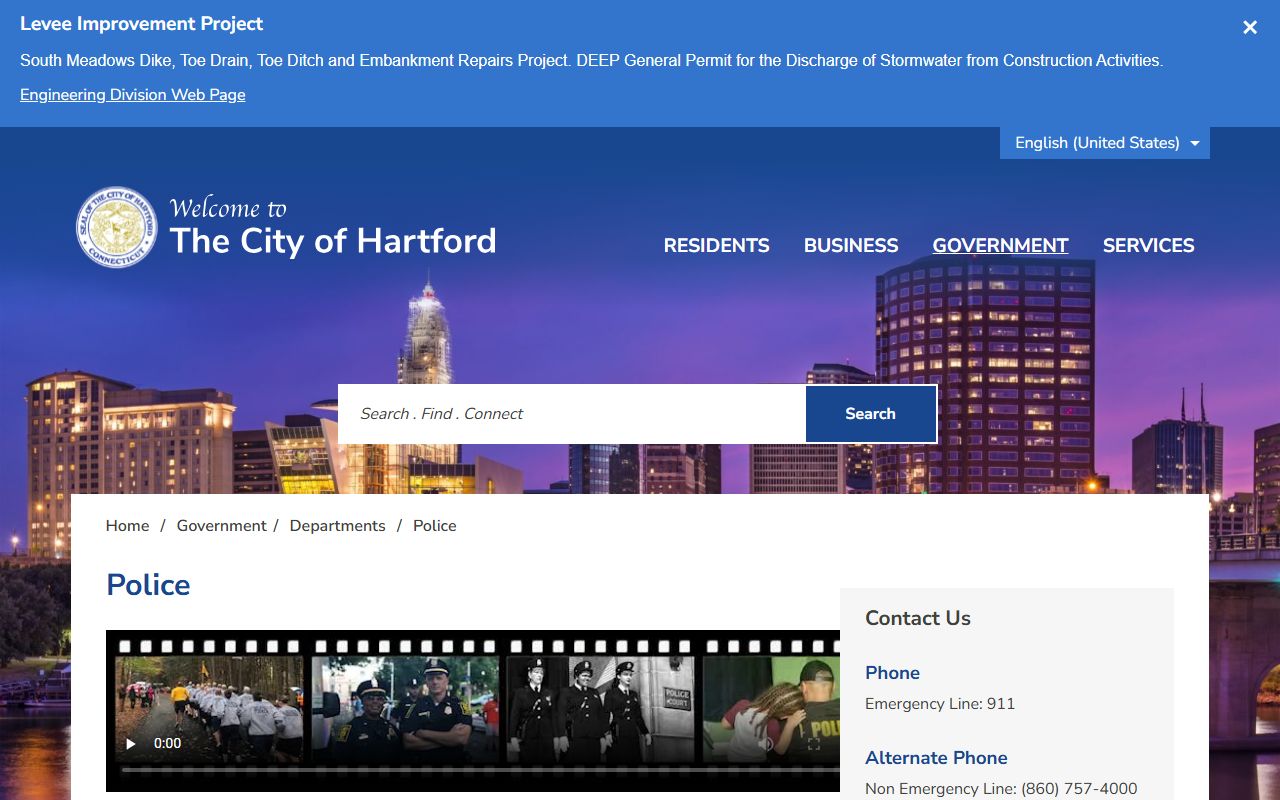
A warrant is a common reason a Hartford County arrest happens, and warrant arrests flow into police and court records. Connecticut has no public active-warrant roster, and Hartford County has no county sheriff warrant list, so warrant information sits across courts, local police, and state law enforcement systems. The Hartford Police daily arrest log shows warrant arrests after they happen, with entries marked as taken into custody on a warrant.
The official Hartford Police records page is where you confirm arrest-log access and file a records request. The screenshot below comes from that page.
Arrest logs and records requests are handled through the Hartford Police Department records page.
Those logs show charges such as 53a-32 violation of probation and 53a-173 failure to appear in the second degree, which are typical warrant-arrest charges. There are several warrant types worth knowing before you search.
- Arrest warrant: judicially authorized custody for a criminal offense.
- Bench warrant or failure to appear: issued when a defendant misses court or breaks court process.
- Violation of probation warrant: can lead to custody or a court appearance.
- Fugitive warrant or hold: may involve another jurisdiction.
- Capias or capias mittimus: a court order for custody in some civil, family, or support matters.
To check on a warrant or a failure-to-appear event, search the Judicial Branch case lookup for the pending case, then work through the court, clerk, or an attorney rather than relying on unofficial lists. If a warrant arrest already happened, the arresting agency's records division holds the arrest record.
Charges vs. Convictions in Court Records
Being arrested and charged is not the same as being convicted. A charge is an accusation. A conviction comes only after a plea or a verdict. The Department of Correction warns plainly that current incarceration does not by itself mean conviction, since the system holds many people on accused status. Reading a court record correctly means checking the disposition, not just the charge.
| Charge | Conviction | |
|---|---|---|
| Stage | Accusation | Plea or verdict |
| Burden of Proof | Probable cause | Beyond a reasonable doubt |
| Final Outcome | Not yet decided | Case resolved against the defendant |
Note: For an official record of convictions rather than pending charges, use the DESPP State Police criminal history process instead of the public case lookup.
Erasure of Court Records After an Arrest
Connecticut clears records through erasure, not the generic idea of expungement. Under Conn. Gen. Stat. section 54-142a, qualifying records can be erased. That includes charges that were dismissed, nolled after the statutory period, ended in acquittal, were pardoned, or became eligible under the state's clean-slate rules. Erasure changes what the public can see and what a person may lawfully say about the erased proceeding. The erasure statute sits in the criminal records chapter of Connecticut law.
| Erased Record | Pending or Convicted Record | |
|---|---|---|
| Public Access | Generally closed to the public | Generally open in the case lookup |
| Qualifying Event | Dismissal, eligible nolle, acquittal, pardon, or clean slate | Charge still pending or a conviction stands |
| What It Does | Lets the person treat the proceeding as erased under the statute | Remains a usable public court record |
Erasure does not reach every copy of a record everywhere. It works on official state records, so a private website or an old news story is a separate matter, and there is no promise that a third party will remove anything. For official erasure questions, the Judicial Branch and the statute itself are the right starting points.
Background Checks and Court Records
A casual court lookup and a formal background check are not the same. The Judicial Branch case lookup answers status questions for free, and the Connecticut FOI Act, section 1-210, keeps many public records open for inspection. A regulated employment or tenant background check is different and must follow federal rules. For an official criminal history, the DESPP State Police process is the proper channel, not a quick case search.
Important: This site is not a consumer reporting agency under the Fair Credit Reporting Act, and its information may not be used for credit, employment, insurance, or tenant decisions.
Restricted Court Records in Hartford County
Not every record after an arrest is open. Online access can be limited or closed for several categories under Connecticut law and court rules. Juvenile cases are generally not public. Records handled under the Youthful Offender statute are restricted. Erased records under section 54-142a are closed to the public. Family violence matters, sealed filings, and records tied to an active investigation can also be withheld.
When a record is restricted, the case lookup may show nothing or only limited entries. The Judicial Branch disclaimer is clear that the online lookup is not the official record, and information that is not online is generally non-disclosable through the clerk's office. For records that are not exempt, a Connecticut FOI Act request to the agency that holds the record is the route, with state agencies allowed to charge a modest per-page copy fee.
Watch for scams. In December 2024, the Hartford State's Attorney's Office warned that it will not call demanding payment by Zelle or threaten jail over a phone investigation; verify any such claim through official court, DOC, and prosecutor contacts.